

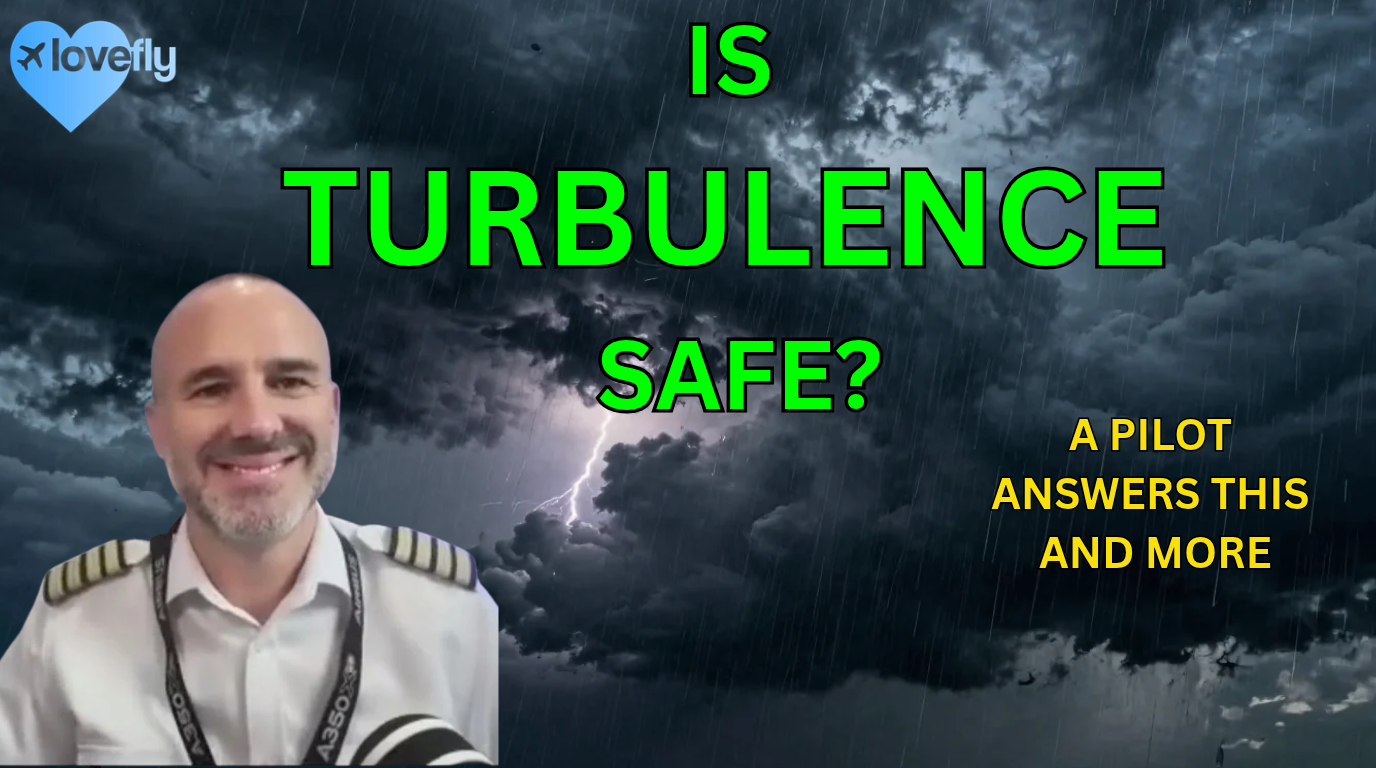
Hello everyone, and welcome back to the Lovefly blog! If you’ve ever found your palms getting a little sweaty just thinking about an upcoming flight—or if you’ve ever stared out at the endless ocean below and wondered, "What happens if something goes wrong out here?"—you are in the right place, and you are so not alone.
In this week’s brand-new podcast episode, I sat down with an absolute powerhouse of aviation knowledge: Captain Simon Belmont (better known online as Flyman Simon). Simon is a long-haul captain flying the magnificent Airbus A350 out of Heathrow. With an incredible background that includes 17–18 years in military service as a fast jet engineer and pilot (flying Tornados and C17s), plus running his airline's command center during the pandemic, Simon brings a rare combination of military precision, airline operational insight, and immense empathy for the nervous flyer.
We dove deep into the questions that keep nervous flyers up at night: flying over vast oceans, name-storms, power banks, and how to conquer that anticipatory spike before the boarding door closes. Let’s unpack the core takeaways to help you feel grounded, informed, and ready for your next adventure.
One of the biggest fears for nervous flyers is the sheer isolation of flying over water—the thought of being hours away from land with nowhere to go if something breaks. Simon shattered this myth with a powerful reassurance: modern commercial airliners are not built on a knife-edge.
"We aren't in an airliner where if something critical fails, you're going down and going to land in the sea... when the critical things go, there's a backup. And it's all documented. It's not down to a single captain shooting from the hip. It's legal, and it's regulated by Airbus, your airline, and your aviation authority."
Simon explained the rigorous standards behind twin-engine ocean crossings (ETOPS—Extended-range Twin-engine Operational Performance Standards). Airlines and aircraft have to prove absolute reliability, meaning that even if a system malfunctions, backup upon backup kicks in. In fact, modern aircraft like the A350 are engineered with multiple electronic and hydraulic redundancies so that even on a reduced system, the aircraft is completely capable of safely landing. You aren't flying on hope; you are flying on meticulous, regulated engineering designed to keep moving forward.
Ah, turbulence—the universal nemesis of the nervous flyer. We’ve all been there: gripping the armrests, holding our breath, and convincing ourselves the plane is plunging out of the sky. Simon offered a brilliant reframe that changes everything: planes don't drop; they get nudged.
"In my 25 years... I have never dropped in an airplane. It’ll just say—I’ve had it feel like we have... but I promise you as a pilot, physically, that airplane doesn't drop. It's had it move about 20 feet, and that's nothing, that's natural movement. It feels like it, but you haven't dropped."
Think of turbulence like driving over a bumpy patch of road or riding a train that's rocking along the tracks. The air is simply moving around the wings, shifting the lift slightly up or down. The autopilot instantly catches and corrects it. The plane is completely secure in its air cushion. The greatest danger in turbulence isn't the aircraft—it's being unbelted. That’s why Simon and I always recommend keeping your seatbelt loosely fastened whenever you're in your seat, just like you would in a car.
During our chat, we welcomed Lovefly community members Janice and Barry into the conversation, who courageously shared their own struggles with pre-flight anxiety and the boarding process. Barry highlighted the tense 15-to-20-minute window from boarding to takeoff.
Simon’s advice for managing that anticipation window is pure gold: keep your brain away from the peak.
"Everything's about just keeping it away from that peak where you're in control... Don't let your brain get to a point where it thinks I'm under threat and I need to fight or flight... The purpose is to keep away from that peak so if you can distract yourself and try and pretend you're not in an airport and you're not about to board a plane and just keep control, you'll feel a huge sense of achievement."
Practically speaking, this means staying occupied—whether that’s listening to guided audio companions (like Lovefly's Paul in Your Pocket or Simon's Pilot Companion), sipping water steadily to signal to your nervous system that you are safe and digesting, or using grounding techniques like the 5-4-3-2-1 sensory method.
If you want to hear the full, unfiltered conversation with Capt. Simon Belmont—including stories from his military days, deep dives into weather radar routing, and wonderful live Q&As with our community members—watch the full podcast episode on YouTube below:
If you're looking for extra support for an upcoming flight, check out Simon's resources, connect with us on the Lovefly Instagram, or explore the tools and supportive community waiting for you right here at Lovefly. You don't have to navigate this journey alone.
Blue skies and happy flying,
Paul Tizzard & The Lovefly Team
Please write a message into this form and we will get back to you as soon as possible.